Testing whether scientific agents, capital, and wet labs can close the loop.
•
13 min read
For the fifth edition of DeSci.Berlin, our home in the old König Gallery space filled up again with researchers, founders, funders, and a growing contingent of autonomous agents working on their behalf. Over two days on 18 and 19 June, the conversation moved past the question of whether science can run onchain and toward a harder one: how much of the scientific process can now run on its own. Across keynotes, fireside chats, and panels, a single thread ran through almost every session; the tooling has matured, and the bottleneck is no longer technology but coordination. Here is what stood out.
Paul Kohlhaas: The Code of Life Is a Public Good
Paul Kohlhaas opened the day by eschewing science as a public good rather than a trade secret; the frontier of science deserves an open ecosystem in the same way that AI does. He walked through the numbers that motivate the entire DeSci movement: drug development that is widely cited at roughly $2.5 billion per drug, a development timeline measured in 15 years, a trial failure rate near 96%, and tens of billions wasted annually on irreproducible research. Against that backdrop, he laid out the four primitives Molecule and BIO are building around: tokenized IP, permissionless funding, an open data ledger with provenance, and autonomous research agents. The goal for all of us is a future of permissionless scientific abundance.
Geeve George: Building the Wet Lab of the Future
BIOS is a powerful AI Scientist. It coordinates specialised subagents for literature search and data analysis, planning and executing multi-step research workflows while you steer. It already lets a researcher take a target such as the GLP-1 receptor and generate binder candidates in silico, running state-of-the-art models that produce a thousand candidates for roughly thirty dollars of compute in an hour or two. The missing piece is validation, which is where robotics enters! Geeve introduced an autonomous lab in a box designed to synthesize peptides and run assays, trained in simulation through reinforcement learning before being transferred to real hardware.
Molecule CPO Kevin Nößler delivered what was, for our team, the heart of the day. Scientific IP is among the most valuable asset classes in existence, with intangible assets representing a $61 trillion dollar opportunity and science roughly a third of that, yet the market infrastructure for it still runs on what he called nineteenth-century rails of paper contracts and glacial timelines. Molecule's mission is to bridge that gap, turning illiquid IP into something verifiable, priceable, and tradable on open infrastructure.
The lesson, after the past few years of building, is to meet users where they are and let the token rails run quietly in the background. That reframing animates Molecule's shift from a set of scattered products toward a single programmable substrate, verifiable by default, that works for humans and agents alike.
Philip Lee: Onchain Labs, the Substrate for Agentic Science
Molecule protocol architect Philip Lee took the room into the machine. He situated agentic research within a sixty-year history that runs from Dendral in 1965 through ADAM to AlphaFold, then explained why this moment is different; the intersection of AI, research, and blockchain delivers four things an autonomous agent has never reliably had. Those are a persistent identity where reputation can accumulate, data and provenance that make outputs verifiable rather than taken on faith, a trustless coordination layer for agents to transact across, and funding that can flow onchain without waiting on a grant cycle.
Phil walked through the features that make it usable and safe: sponsored transactions that remove the painful first five minutes for a researcher who knows nothing about blockchain, scoped roles for owners, contributors, viewers, and agents, and configurable guardrails. Permissions are bound to the owner and revoked the moment the lab changes hands, and a curated Module Registry, designed to open up to community builders over time, governs what capabilities a lab can install. The architecture also models how research actually works; a single lab can hold many parallel lines of inquiry, and a failed experiment becomes a valuable data point rather than a catastrophic loss.
Maria Sanmartin: The Molecule Labs Product Experience
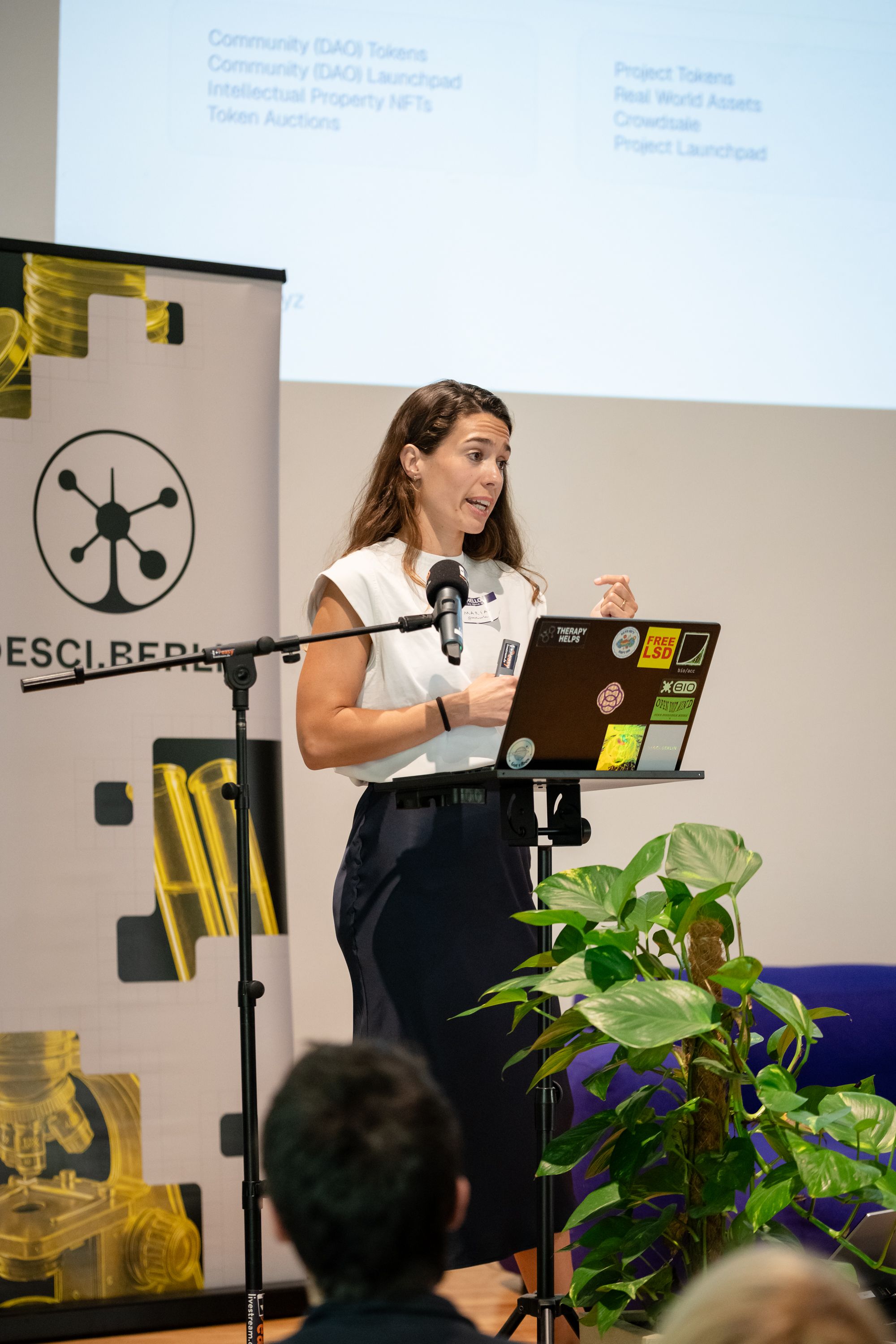
Senior product manager Maria Sanmartin picked up where Phil left off, walking through the interaction layer that sits on top of the protocol. She framed it through the hypotheses Molecule has validated year by year: that crypto could fund science in 2023, that assets could become tokens and back again in 2024, and that AI and agentic workflows would reshape everything in 2025. This year's hypothesis is posed as a question the whole team is testing; can science run autonomously?
Maria demonstrated how a researcher can spin up a lab in minutes, attach a data room, add contributors with scoped permissions, and drop in decks, datasets, and milestones that are versioned, timestamped, and permanently stored. Every action generates a public record on a project page, so funders can review a verifiable track record without chasing project leads for information. She also showed MIRA, Molecule's own AI agent, which reads public lab data, runs a project evaluation framework, and returns an assessment of where a project sits on the technology readiness scale, accessible through the product or via an MCP and chatbot.
Bradley Clark Royes: Physical Infrastructure for Decentralised Science
Bradley, Node Manager for the Foresight Institute in Berlin, began with an anecdote about researchers in his node; they had built workflows around the latest Anthropic model, until a government order severed their access. His point: if you do not own, host, or run a model, you cannot control your access to it. Roughly 90% of notable frontier models come out of industry, and roughly 90% of academics lack access to them, a gap that is even starker in places like Africa.
His answer is a new primitive he calls an AI node: a physical space with compute, grants, and a community. Bradley argued that the DeSci movement already has material capabilities and ideology in abundance; what it lacks are institutions, the physical places where interdisciplinary work actually happens.
A Physician's Perspective on Peptides (@RealAaronWeaver)
In a fireside chat Aaron Weaver spoke with Dr Mohsen Soofian, a board-certified family physician who has used peptides in clinical practice for almost a decade. Dr. Soofian was emphatic about sourcing only from licensed compounding pharmacies, warning that research chemicals sold online operate in a regulatory gray zone and can carry impurities and heavy metals. He walked through where peptides have shown genuine clinical value, particularly for musculoskeletal injuries that would otherwise head to surgery, while being equally clear about the gaps. His central plea was for evidence; large, randomised, controlled trials that would replace extrapolation from animal models with the hard data clinicians actually need.
Dr. Aubrey de Grey: Taking Rejuvenation to Longevity Escape Velocity (@aubreydegrey)
Longevity researcher Dr. Aubrey de Grey framed aging as two coupled processes: metabolism that causes molecular and cellular damage throughout life, and the pathologies that emerge once that damage exceeds what the body can tolerate. The distinction between the diseases of aging and aging itself, he argued, is largely semantic, which is why trying to manage the pathologies directly is, in his words, hopeless. His alternative is preventative maintenance; removing the damage rather than interfering with metabolism.
He shared results from LEV Foundation's recent study, which combined four interventions in middle-aged mice. The team did not hit its stretch goal of twelve additional months of life, achieving roughly four, but it did demonstrate the additive effect it set out to prove; the mice receiving all four treatments outlived every partial-treatment group. He previewed a far larger study of two thousand mice combining at least eight interventions, supported by VitaDAO-funded pilots and smart cages that capture continuous health data that the DeSci community will be able to analyse in real time.
Benjamin Snipes: The Compliant Path From Community to Cap Table
Benjamin Snipes opened the second with the Coin-to-Company model, which Snipes described as an attempt to marry the egalitarian power of token communities with the venture-backed equity structures that institutional capital understands. The key move is structural separation; tokens remain freely tradable digital commodities, while equity sits on top of them through well-established US pathways, with locked tokens used to identify shareholders and instruct the company. It works under current law without waiting on the Clarity Act, and it is designed to interface with traditional universities and venture funds that may never want to touch crypto directly. Pept.ai is already being brought onto the model, with other projects following.
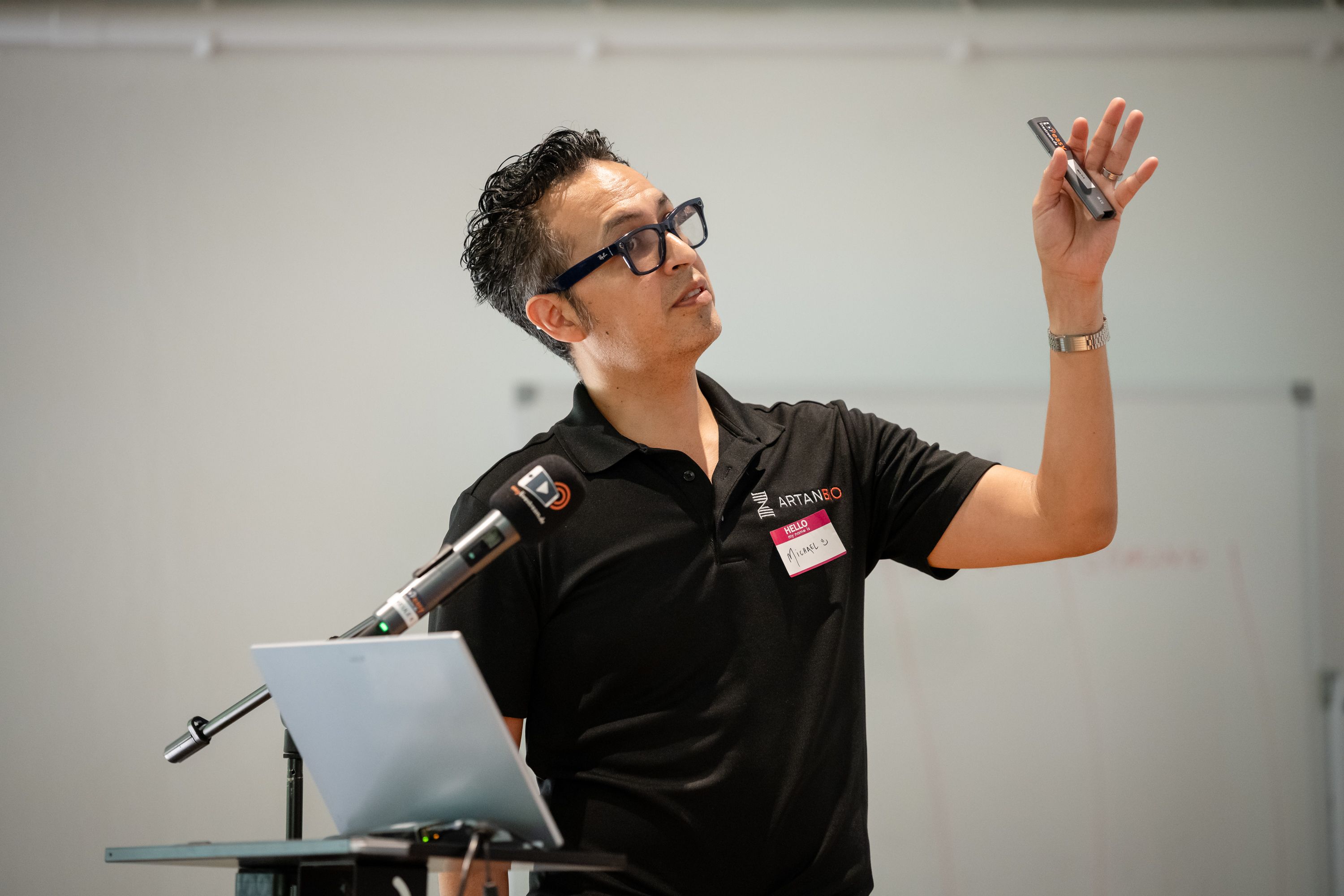
Dr. Michael Torres: From DeSci to Drug Development
Few stories captured the conference's sense of momentum better than Dr. Michael Torres. A traditional biotech builder with a PhD in cancer biology, Torres recently sold his company Crossbridge Bio to Eli Lilly for $300 million dollars, and he has now gone fully into DeSci. His pitch was about incentive alignment; traditional biotech keeps innovators private and heavily diluted until a distant exit, while tokenized IP, liquid fractional ownership, and onchain milestones create earlier upside for the people actually building the medicines.
He grounded it in the science behind Vita RNA. The work targets a hypermutable arginine codon whose corruption introduces premature stop codons into critical proteins involved in DNA repair, tumour suppression, and neuroprotection, with hallmarks of accelerated aging. Torres showed early data rescuing the p53 tumour suppressor, then described a deliberately capital-efficient development path and several product routes, including a microneedle skincare formulation built from cosmetic-friendly lipids. The structure tying it together, layering ARTAN Bio, the IP-holding entity, and the VitaRNA token, weaves the DeSci story.
From Prompt to Peptide: The Legal and Scientific Panels
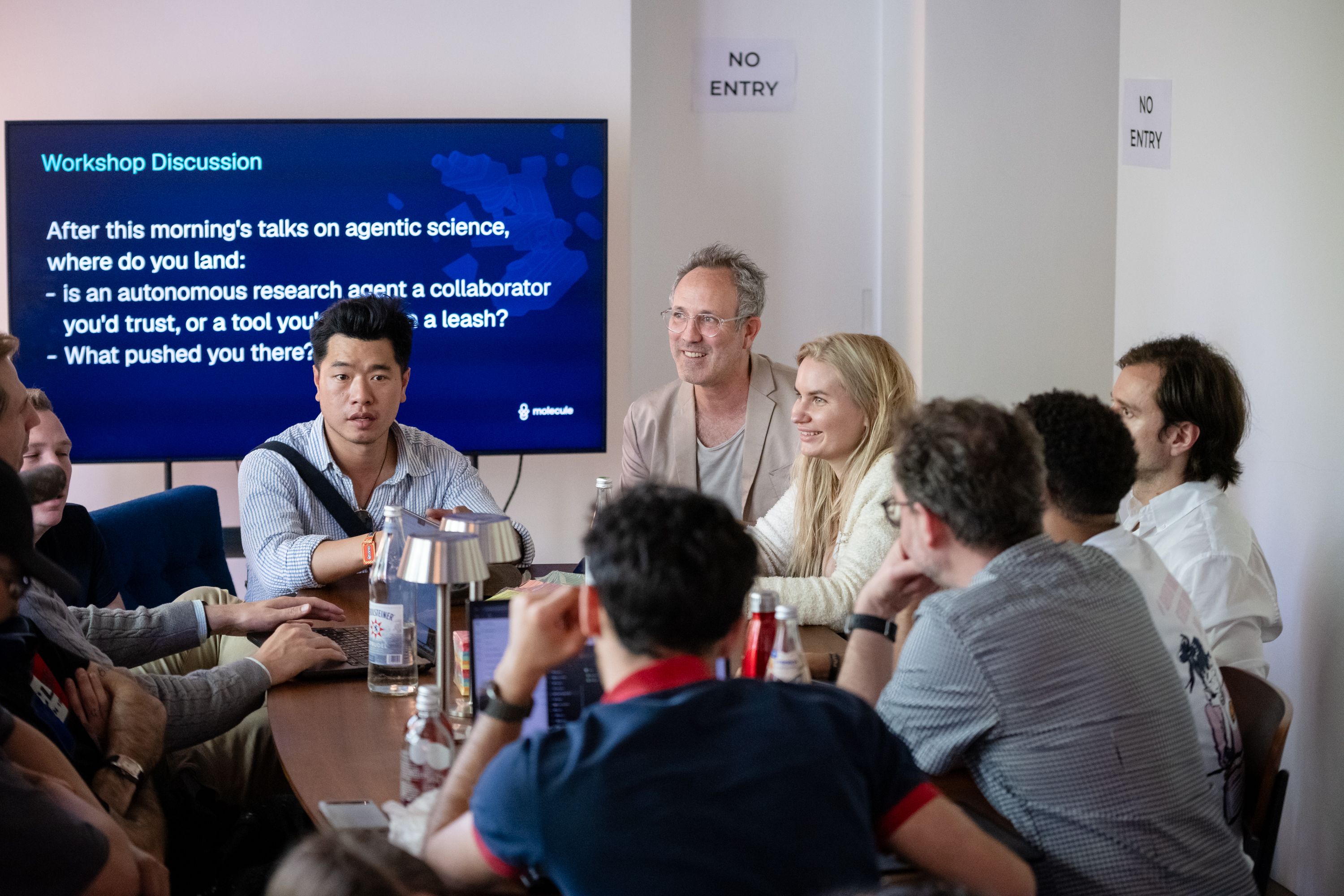
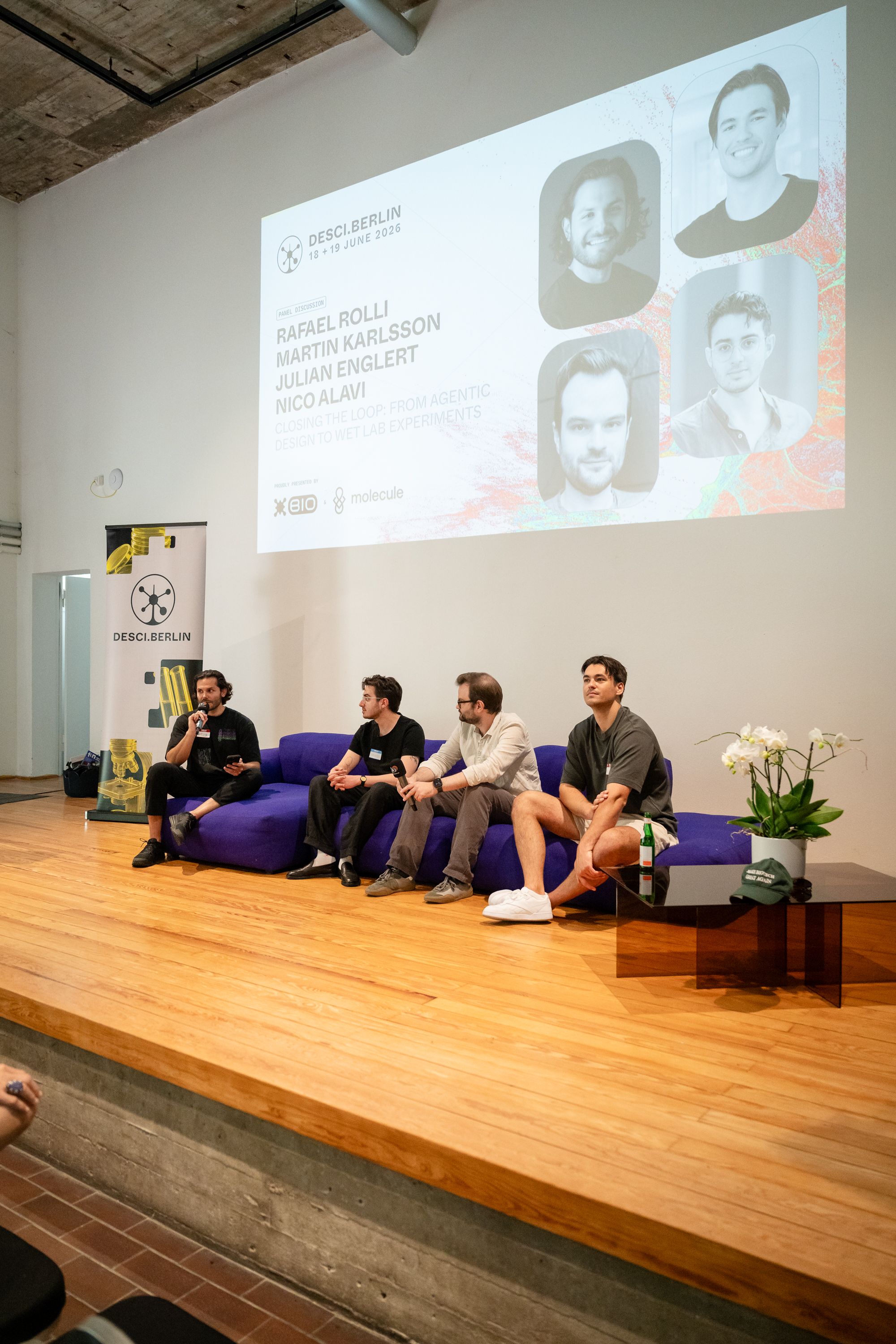
The second day's panels brought the threads together. Discussions led by Rafael Alain Rolli moved from research design through to wet lab execution and the legal scaffolding of self-driving science, closing the conceptual loop the conference had been circling: an agent can be prompted toward a target, generate and triage candidates, route funding onchain, and hand validated designs to a robotic lab, all within a structure that keeps the resulting IP ownable and compliant. The recurring lesson was that none of these layers is sufficient alone; the value emerges where computational design, physical validation, capital, and legal structure reinforce one another.
Where This Leaves Us
The infrastructure is no longer the bottleneck; agents have a place to act from, capital has a compliant path into real ownership, and the wet lab is starting to answer to the same systems that design its experiments. What remains is the patient work of earning trust through outcomes, We are really excited about what comes next. To the researchers, funders, and builders who filled the room, thank you; the future of science is being built in the open, and we are glad to be building it with you. We will see you at the next one.
About Molecule
Molecule is dedicated to advancing scientific research through democratized funding and the tokenization of intellectual property (IP). By transforming IP into liquid, onchain assets, Molecule aligns the incentives of researchers and funders, fostering a more collaborative and efficient research ecosystem.